
Reposting this from The Escher Cycle.
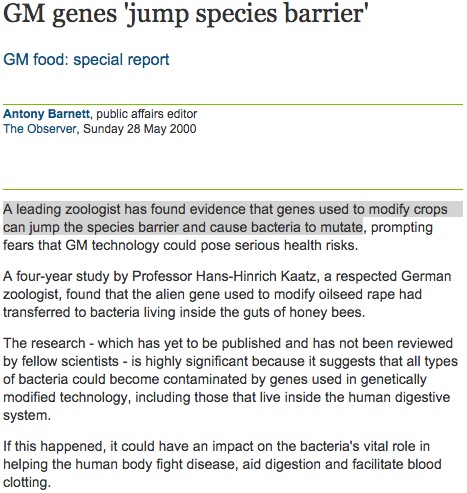 This article from the Guardian in the year 2000 states:
“A leading zoologist has found evidence that genes used to modify crops can jump the species barrier and cause bacteria to mutate.”
This will come as no surprise to anyone who has read The Escher Cycle.
We are brought up to believe that species evolve. But Gregory Bateson showed us that it is ecosystems that are the unit of evolution, not species. The whole ecosystem evolves together.
One mechanism by which this happens is mechanistic: faster cheetah cause faster antelope, and faster antelope cause faster cheetah. Insects that prosper later in the year lead to birds that have their chicks later in the year, and so on.
And another mechanism of evolution is the jumping of genes between organisms. After all, we all evolved from the same basic organisms, and humans share approximately 98% of their DNA with chimps, 70% with slugs and 50% with bananas. So why wouldn’t we expect that a newly-arrived gene would make itself right at home?
The appendix of The Escher Cycle demonstrates how this happens. It shows how the circular understanding of business developed in the earlier part of the book also applies to nature.
The appendix shows how evolution has two parts: within species and across species. Intra-species and inter-species.
Gregory Bateson also told us that it is differences between the way we think the world works and the way the world actually works that cause most of the problems in the world. The cholera outbreaks in London during the 1800s would be one example. GM bacteria in our stomach that no longer help us fight disease, digest food, or clot our blood would be another.
But when we understand how the world really works then we can also find new opportunities. Understanding that cholera was caused by bad water, not bad air, allowed us to build the sewers and piped water systems that enabled the massive cities we have today. Understanding that the world was round and not flat enabled Columbus to discover America.
Understanding how species and the economy truly evolve can help us to design and run businesses in a way that is more in line with nature, more sustainable, and more successful.